AI
AI News

Latest AI News

HexFormer: Hyperbolic Vision Transformer with Exponential Map Aggregation

HexFormer: Hyperbolic Vision Transformer with Exponential Map Aggregation

Researchers have developed HexFormer, a hyperbolic vision transformer for image classification that employs exponential map aggregation in its attention mechanism. The architecture includes both a hyperbolic variant and a hybrid version that merges a hyperbolic encoder with an Euclidean classification head. Experiments show HexFormer outperforms standard Euclidean models and previous hyperbolic transformers across various datasets, with the hybrid variant achieving the best results. The study also highlights that hyperbolic models offer improved gradient stability and reduced sensitivity to training strategies, suggesting practical advantages in using hyperbolic geometry for vision tasks.

arXiv

Learn and Verify: A Framework for Rigorous Verification of Physics-Informed Neural Networks

Learn and Verify: A Framework for Rigorous Verification of Physics-Informed Neural Networks

A new "Learn and Verify" framework addresses the shortcomings of neural networks in solving differential equations by providing computable error bounds. It merges a Doubly Smoothed Maximum loss for training with interval arithmetic for verification, yielding rigorous a posteriori error bounds. Successful numerical tests on nonlinear ODEs show its potential for reliable scientific machine learning applications.

arXiv
Diffusion for De-Occlusion: Accessory-Aware Diffusion Inpainting for Robust Ear Biometric Recognition

Diffusion for De-Occlusion: Accessory-Aware Diffusion Inpainting for Robust Ear Biometric Recognition

A study evaluates a diffusion-based ear inpainting technique aimed at improving ear recognition systems hindered by occlusions from accessories like earrings and earphones. The model reconstructs occluded ear regions while maintaining anatomical accuracy. Tests across various vision transformer models reveal that this technique enhances recognition performance, demonstrating its practical utility in biometric applications.

arXiv
Airtable gets into the AI agent game with Superagent | TechCrunch

Airtable gets into the AI agent game with Superagent | TechCrunch

Airtable's CEO Howie Liu is moving forward with the launch of a new product line despite the company's valuation dropping by two-thirds. Liu believes this initiative will position Airtable for growth and innovation in the competitive software market. The new products aim to enhance user experience and expand Airtable's capabilities, reflecting a strategic pivot amid financial challenges.

TechCrunch
China's Moonshot releases a new open-source model Kimi K2.5 and a coding agent | TechCrunch

China's Moonshot releases a new open-source model Kimi K2.5 and a coding agent | TechCrunch

China's Moonshot AI, supported by Alibaba and HongShan, has launched Kimi K2.5, an open-source AI model capable of processing text, images, and video. This advancement positions Kimi K2.5 as a versatile tool for developers, potentially enhancing applications in content creation and multimedia analysis. The release reflects China's ongoing investment in AI technology, aiming to bolster its competitive edge in the global market.

TechCrunch
Where Tech Leaders and Students Really Think AI Is Going

Where Tech Leaders and Students Really Think AI Is Going

The article discusses the challenges of navigating uncertainty in today's fast-paced world, marked by significant political, technological, cultural, and scientific changes. It emphasizes the difficulty of predicting future trends and highlights the necessity for adaptability and critical thinking in decision-making. The piece suggests that individuals and organizations should cultivate resilience and remain informed to effectively respond to ongoing transformations.

Wired
All rise for JudgeGPT

All rise for JudgeGPT

In her article, Lauren Feiner explores the potential of AI to address inefficiencies within the legal system. She highlights specific applications, such as predictive analytics for case outcomes and AI-driven document review, which could streamline processes and reduce costs. However, she also notes concerns about bias in AI models and the need for regulatory oversight to ensure fairness and transparency in legal proceedings. The article argues that while AI could enhance efficiency, careful implementation is crucial to avoid exacerbating existing disparities.

The Verge
ctELM: Decoding and Manipulating Embeddings of Clinical Trials with Embedding Language Models

ctELM: Decoding and Manipulating Embeddings of Clinical Trials with Embedding Language Models

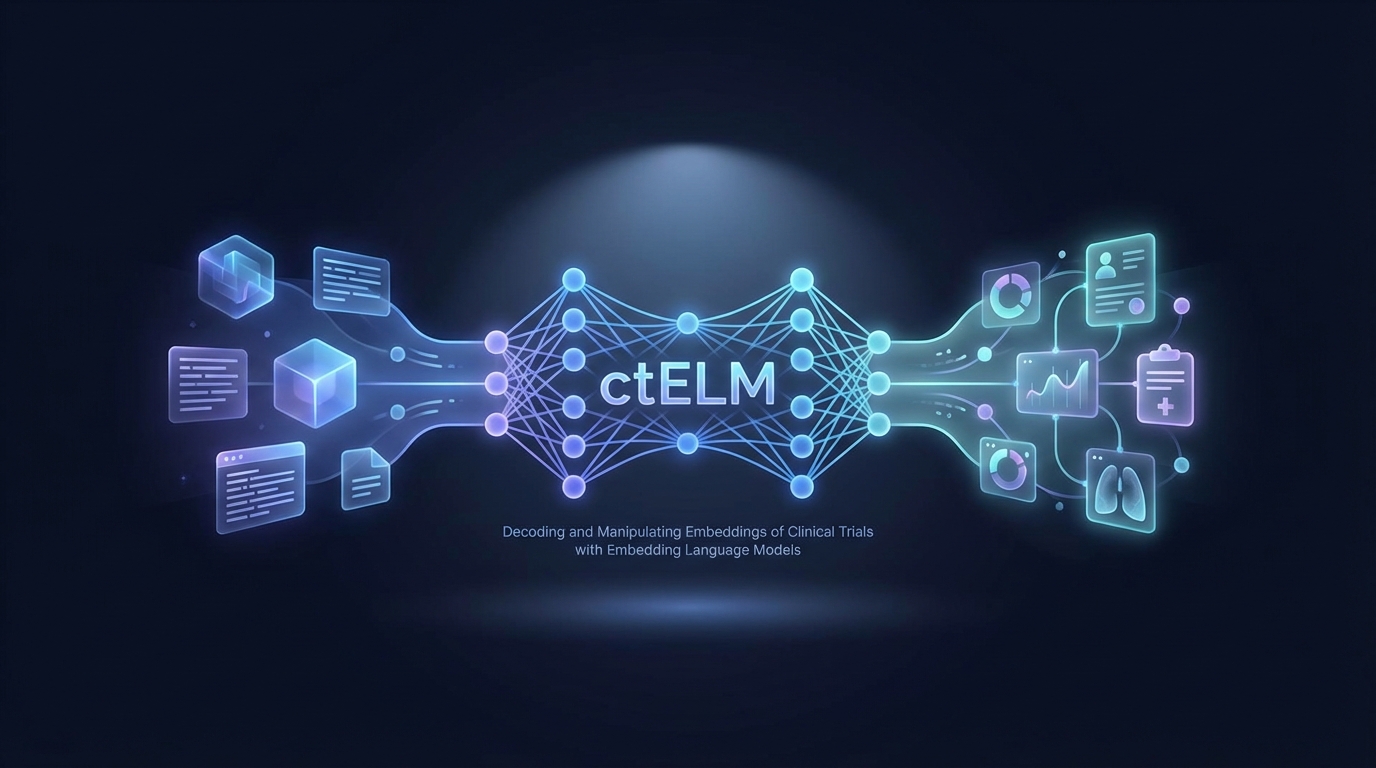
Researchers have developed a new open-source framework called ctELM for aligning Large Language Models (LLMs) with clinical trial embeddings using the Embedding Language Model (ELM) method. This framework enables accurate descriptions and comparisons of clinical trials from embeddings and can generate plausible trial abstracts based on concept vectors like age and sex. The implementation aims to enhance transparency and generative capabilities in biomedical applications.

arXiv
Multi-Objective Reinforcement Learning for Efficient Tactical Decision Making for Trucks in Highway Traffic

Multi-Objective Reinforcement Learning for Efficient Tactical Decision Making for Trucks in Highway Traffic

A new multi-objective reinforcement learning framework using Proximal Policy Optimization addresses the complex trade-offs in highway driving for heavy-duty vehicles, balancing safety, energy efficiency, and time efficiency. It generates a continuous set of Pareto-optimal policies, allowing for flexible driving behavior adjustments without retraining. This adaptable approach enhances decision-making for autonomous trucking, evaluated on a scalable simulation platform.

arXiv
Trust, Don't Trust, or Flip: Robust Preference-Based Reinforcement Learning with Multi-Expert Feedback

Trust, Don't Trust, or Flip: Robust Preference-Based Reinforcement Learning with Multi-Expert Feedback

TriTrust-PBRL (TTP) is a new framework designed to enhance preference-based reinforcement learning by addressing challenges posed by heterogeneous annotators. Unlike existing methods, TTP learns both a reward model and expert-specific trust parameters, allowing it to identify and invert adversarial feedback. This leads to significant robustness, as demonstrated in diverse tasks like MetaWorld and DM Control, where TTP outperforms current PBRL approaches, maintaining high performance even with unreliable feedback. The framework operates without needing detailed expert features, making it a seamless addition to existing systems.

arXiv
Microsoft’s latest AI chip goes head-to-head with Amazon and Google

Microsoft’s latest AI chip goes head-to-head with Amazon and Google

Microsoft has begun the rollout of its Maia 200 chip across its data centers. This new chip is designed to enhance processing capabilities and improve efficiency for cloud services. The Maia 200 aims to support a variety of workloads, potentially boosting performance for AI and machine learning applications. This upgrade aligns with Microsoft's strategy to optimize its infrastructure and reduce operational costs. Further details on performance metrics and deployment timelines are expected in the coming weeks.

The Verge