Multi-Objective Reinforcement Learning for Efficient Tactical Decision Making for Trucks in Highway Traffic
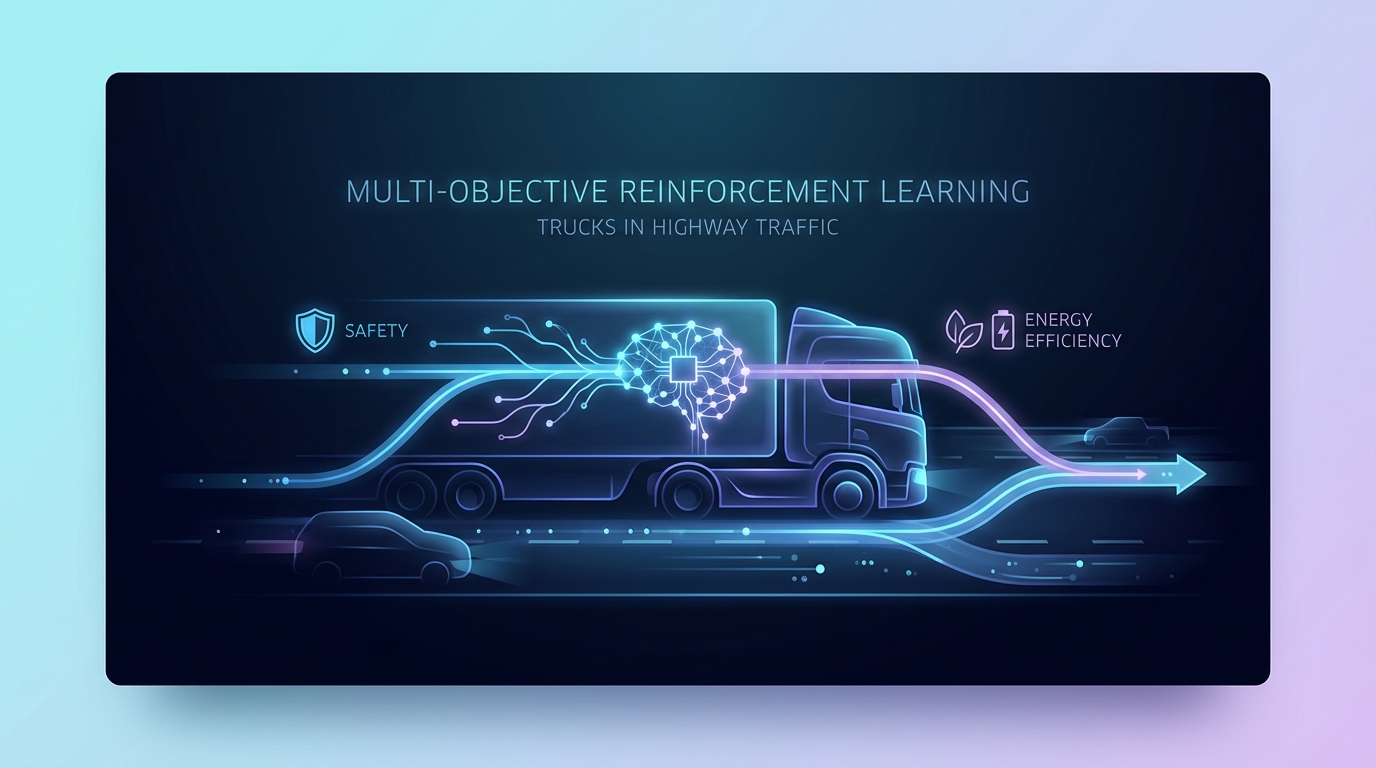
Image generated by Gemini AI
A new multi-objective reinforcement learning framework using Proximal Policy Optimization addresses the complex trade-offs in highway driving for heavy-duty vehicles, balancing safety, energy efficiency, and time efficiency. It generates a continuous set of Pareto-optimal policies, allowing for flexible driving behavior adjustments without retraining. This adaptable approach enhances decision-making for autonomous trucking, evaluated on a scalable simulation platform.
New Multi-Objective Reinforcement Learning Framework Enhances Decision-Making for Highway Trucks
A recent advancement in multi-objective reinforcement learning presents a novel framework designed to optimize decision-making for heavy-duty trucks in highway traffic. This approach addresses the balancing act between safety, energy efficiency, and operational costs, which has posed challenges for autonomous vehicles.
Researchers have developed a Proximal Policy Optimization (PPO) based system that generates a continuous spectrum of policies, representing the trade-offs among competing objectives. The framework has been tested on a scalable simulation platform, showcasing its potential in real-world applications.
Key Features of the Framework
The proposed framework focuses on three primary objectives:
- Safety: Measured through the frequency of collisions and successful driving tasks.
- Energy Efficiency: Assessed through energy costs incurred during operation.
- Time Efficiency: Evaluated based on costs associated with driver time.
This approach results in a smooth and interpretable Pareto frontier, allowing for flexible decision-making based on varying priorities among conflicting objectives.
Implications for Autonomous Trucking
The implications of this framework are significant for autonomous trucking, enhancing operational efficiency and safety in the deployment of autonomous heavy-duty vehicles.
Related Topics:
📰 Original Source: https://arxiv.org/abs/2601.18783v1
All rights and credit belong to the original publisher.