Function-Space Decoupled Diffusion for Forward and Inverse Modeling in Carbon Capture and Storage
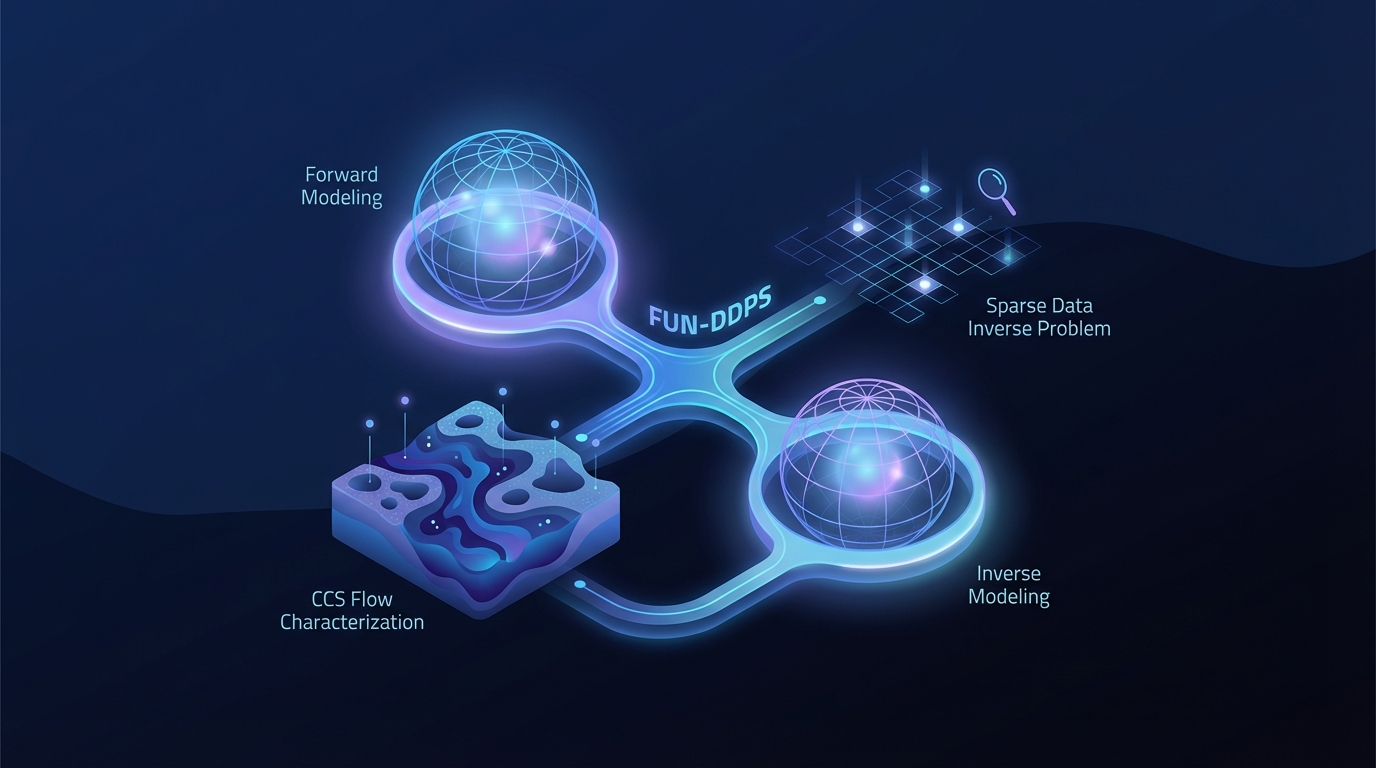
Image generated by Gemini AI
A new framework, Fun-DDPS, enhances subsurface flow characterization for Carbon Capture and Storage (CCS) by addressing challenges in inverse problems with sparse data. It combines diffusion models with neural operator surrogates, achieving a 7.7% error in forward modeling with just 25% observations—an 11x improvement over standard methods. Fun-DDPS also validates diffusion-based inverse solvers against rejection sampling, yielding physically consistent results with 4x better sample efficiency. This advancement could significantly improve data assimilation in CCS efforts.
New Framework Enhances Carbon Capture and Storage Modeling
A novel generative framework, Fun-DDPS, aims to improve the modeling of subsurface flow in Carbon Capture and Storage (CCS) applications. This approach addresses challenges posed by inverse problems and sparse observational data, demonstrating superior performance over traditional methods.
Fun-DDPS merges function-space diffusion models with differentiable neural operator surrogates for modeling. It learns a prior distribution of geological parameters through a single-channel diffusion model and utilizes a Local Neural Operator (LNO) surrogate for physics-consistent guidance. This technique enables Fun-DDPS to recover missing information in parameter space while enhancing data assimilation.
Performance Improvements
The efficacy of Fun-DDPS was evaluated using synthetic modeling datasets for CCS, yielding two significant findings:
- Forward Modeling Efficiency: Using only 25% of available observations, Fun-DDPS achieved a relative error of 7.7%, a substantial improvement over standard surrogate models, which recorded a relative error of 86.9%.
- Inverse Modeling Validation: Fun-DDPS was validated against asymptotically exact Rejection Sampling (RS) posteriors, achieving a Jensen-Shannon divergence of less than 0.06 compared to ground truth data, and a fourfold increase in sample efficiency compared to rejection sampling.
Related Topics:
📰 Original Source: https://arxiv.org/abs/2602.12274v1
All rights and credit belong to the original publisher.