Deep-learning-based pan-phenomic data reveals the explosive evolution of avian visual disparity
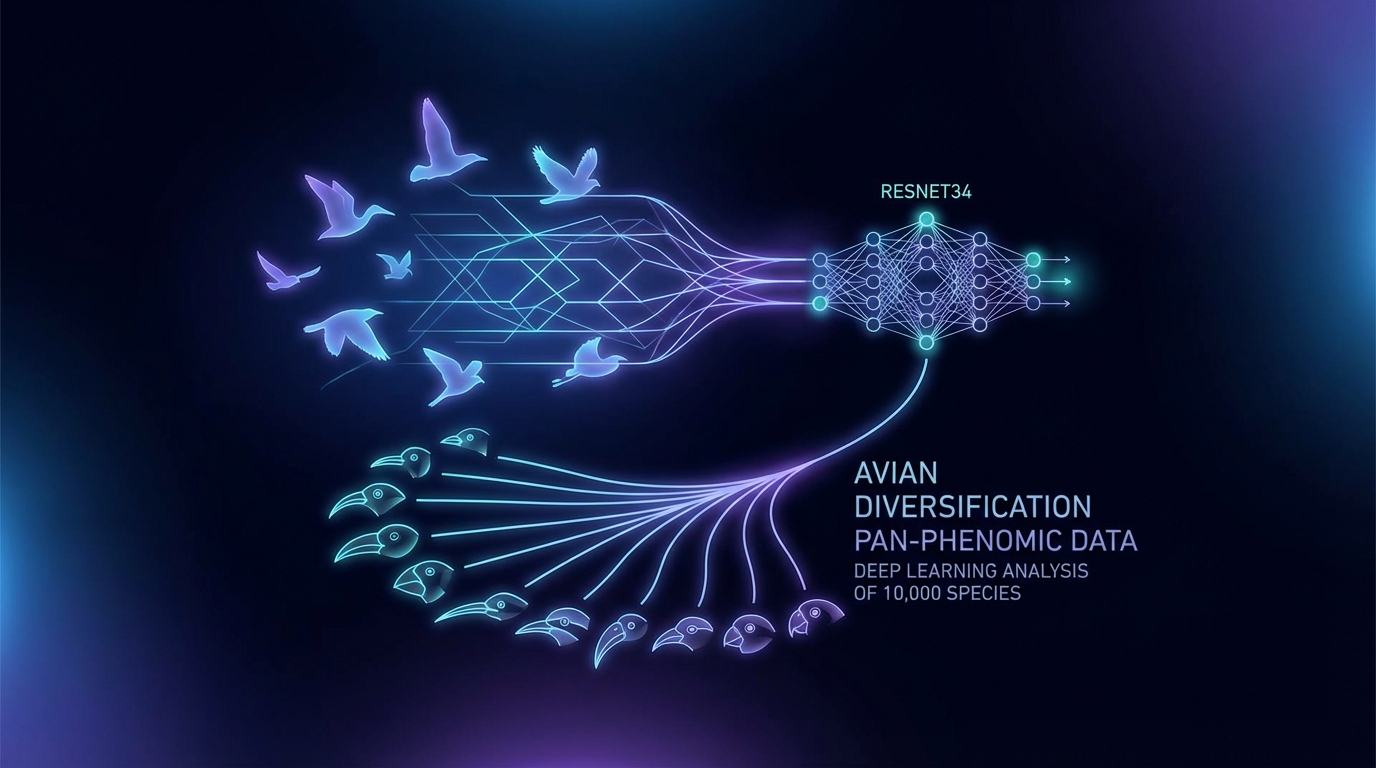
Image generated by Gemini AI
A recent study harnesses deep learning, specifically a ResNet34 model, to analyze avian morphological evolution by recognizing over 10,000 bird species. It reveals that the model's high-dimensional embedding space captures phenotypic convergence and morphological disparity linked to species richness, underscoring richness as a key factor in morphospace expansion. Post-K-Pg extinction patterns show an "early burst" in diversity. Notably, the study also highlights the model's ability to form hierarchical structures in a flat-label training context, challenging assumptions about CNNs' reliance on local textures.
Deep Learning Unveils Avian Visual Disparity Evolution
Recent research employing deep learning techniques has uncovered significant insights into the evolution of avian morphology, revealing a complex relationship between morphological disparity and species richness. By utilizing a ResNet34 model capable of recognizing over 10,000 bird species, researchers have advanced the understanding of avian visual evolution.
Key Findings from the Study
- The morphological disparity among different bird taxa was assessed, revealing a strong association with species richness.
- Species richness emerged as the primary driver of morphospace expansion, influencing the diversity of avian forms.
- A disparity-through-time analysis indicated a pronounced "early burst" of visual diversity following the Cretaceous-Paleogene (K-Pg) extinction event.
The model exhibited the emergence of hierarchical semantic structures reflective of biological taxonomy, suggesting that deep learning models can capture complex relationships within biological data. Additionally, the study demonstrated that the model could effectively learn holistic shape representations, challenging the notion that CNNs primarily depend on texture cues for classification.
Related Topics:
📰 Original Source: https://arxiv.org/abs/2602.03824v1
All rights and credit belong to the original publisher.