Decoupled Diffusion Sampling for Inverse Problems on Function Spaces
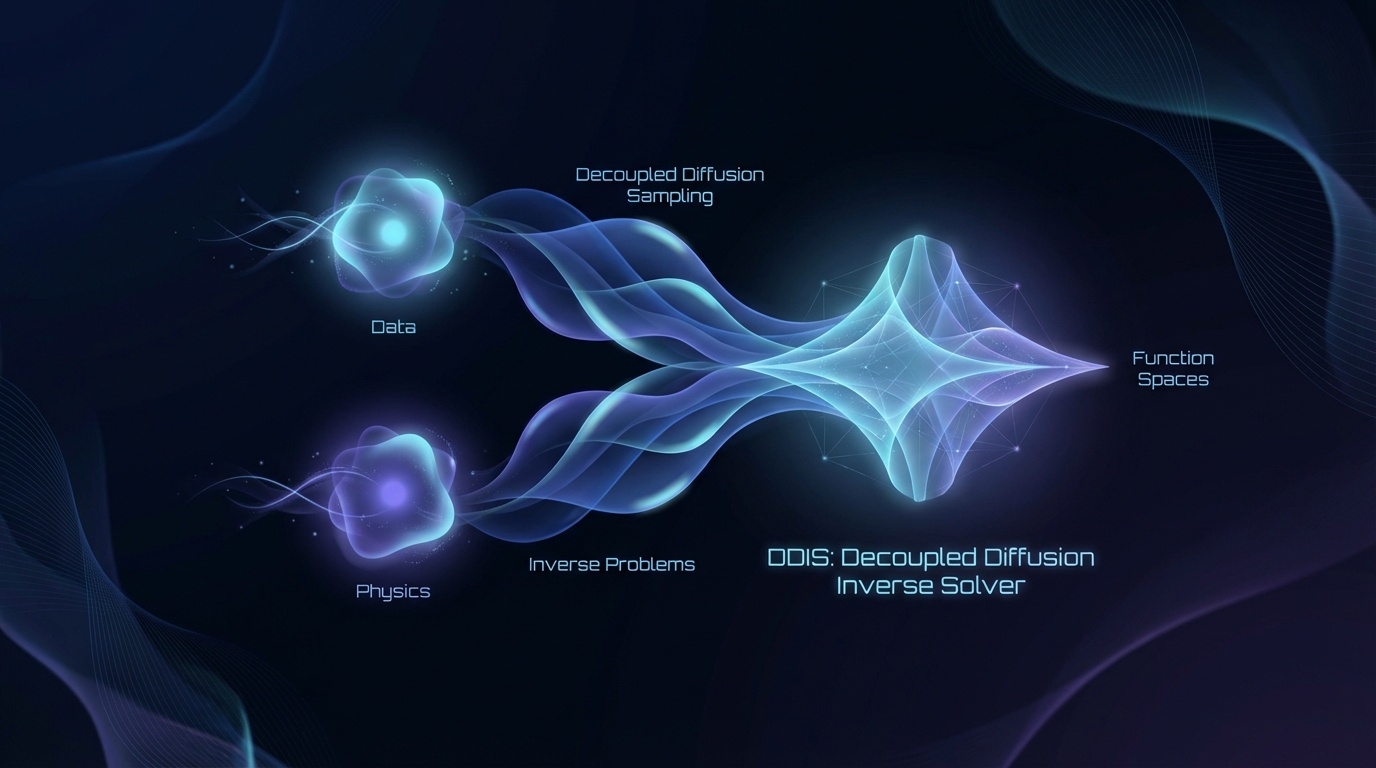
Image generated by Gemini AI
The Decoupled Diffusion Inverse Solver (DDIS) introduces a novel framework for solving inverse PDE problems, emphasizing data efficiency and physics-awareness. Unlike traditional models that require extensive paired data, DDIS separates coefficient and solution learning, leading to an 11% improvement in $l_2$ error and a 54% reduction in spectral error under sparse data conditions. Notably, when trained with just 1% of available data, DDIS outperforms joint models by 40% in $l_2$ error, showcasing its effectiveness in low-data scenarios.
New Framework Improves Data Efficiency in Inverse PDE Problems
A novel generative framework, the Decoupled Diffusion Inverse Solver (DDIS), promises enhanced data efficiency and performance in inverse partial differential equation (PDE) problems. DDIS offers significant improvements over existing methods that rely heavily on paired supervision.
DDIS utilizes an unconditional diffusion process to learn the coefficient prior, while a neural operator explicitly models the forward PDE. This decoupling strategy fosters improved data efficiency and supports Decoupled Annealing Posterior Sampling (DAPS), addressing the over-smoothing issue found in Diffusion Posterior Sampling (DPS).
Enhanced Performance Metrics
Theoretical analysis confirms that DDIS circumvents the guidance attenuation failure associated with joint models, especially with limited training data. Empirical evaluations show that DDIS achieves state-of-the-art results, with:
- Average improvement of 11% in $l_2$ error.
- Average reduction of 54% in spectral error.
- In scenarios where data is restricted to 1%, DDIS maintains a 40% advantage in $l_2$ error over joint models.
Related Topics:
📰 Original Source: https://arxiv.org/abs/2601.23280v1
All rights and credit belong to the original publisher.